


The music industry loves to talk about fan community. It shows up in label pitches, in artist rollouts, in every panel about the future of the business. But knowing how to talk about fan communities and knowing what it actually feels like to be inside one are two very different things.
Victoria Hamersky knows the difference. She grew up a concert girlie, built her network camping outside venues, and joined Stan Twitter the same way everyone else did — she just ended up building a career out of it. Now, as the founder of VH MGMT Group and a former A&R at Elektra and Atlantic Records, she’s one of the people in the room who actually lived it first.
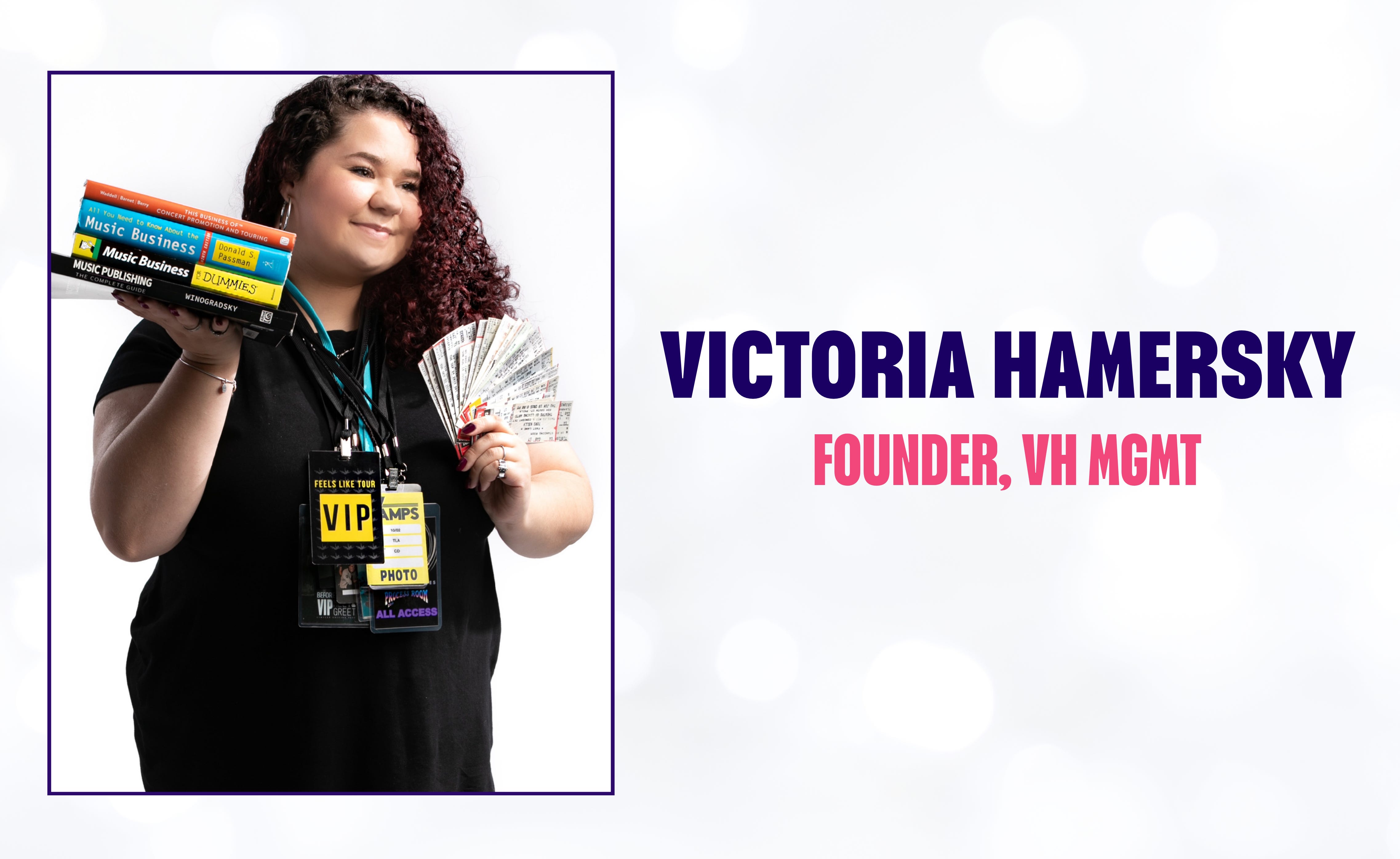
Below, she talks about wearing every hat until you don't have to, why fangirls deserve a seat at the table, and where the industry's diversity problem runs deeper than most admit.
You’ve worked across so many areas of the music industry — from VIP and touring to artist management and A&R. At the core of all of it, how do you define the role you play?
The overarching term would be music industry professional, because when you are an artist manager working for a developmental artist that’s not signed to a major, you are playing literally every role — you’re the manager, you’re the agent, you’re the lawyer, you’re the graphic designer, you do everything. You have to be prepared for everything.
Getting to work outside of management and do A&R and touring, I’m meeting so many people that are growing my network, and that benefits my artists at the end of the day. Like, I DM’d a manager one day — “Hey, my artist is a huge fan of yours, I’d love for them to get coffee, if not, no worries.” A week later they were like, “Actually, do you want them to open my New York show?” Then Nashville got added. Then, “Do you want to open for the whole tour?” Say less. Mind you, I met that manager through working in concerts and touring.
You do have to wear all of the hats until those services are given to you by being signed to a label, or if your artist gets absorbed by a larger management company. But then also same thing, if your artist can afford to hire a publicist, I no longer have to be the publicist. But, I love it. It makes me who I am. Everything that I do always comes back to connecting my artists, and I feel like at the end of the day, getting to be in A&R, getting to see what a lot of these artists on the major system have gone through, or what the processes really look like for these internal conversations or deals — it makes me more aware and knowledgeable of how to protect my artists and my personal clients as well.
You’ve said you were a fan first. How does that perspective shape the way you work with artists?
It’s 100% of who I am as a manager. My boss at Elektra and Atlantic is also a fangirl, and she wanted people like-minded like her on the team to see something she might not.
She said something recently that really stuck with me, “You were really passionate about this, and that’s why I wanted to listen to it.” And it just took me being overly passionate. I can see the vision, I can see a fan base brewing quickly. Sometimes you can look at an artist on the rise and just automatically know it’s going to happen for them.
In high school and college, I ran an interview series on my blog called On the Rise, from when I was about 15 through 22, over 100 artists. I interviewed Chappell Roan, Noah Kahan, Gracie Abrams, Griff, Maisie Peters — all when no one really knew who they were. The ten-year overnight success theory is kind of a thing, and being a fangirl has given me an edge that a lot of managers I’ve worked with don’t have. They don’t have the understanding of fandom, or just what it’s like to be so immersed with an artist because they’ve built a world their fans feel warm and safe in.
There’s no music industry, no money, no job without the fans. You can’t sell out a show to zero people. If you’re not actively working towards helping that artist develop and understand their fan base, you’re not selling tickets, you’re not selling records, you’re not selling merch. Fangirls deserve a seat at the table because their opinions and ideas matter. That’s what’s different about me — that been there, done that experience.
Where do you still see gaps between what the industry says it values and what actually gets supported?
The industry has made great strides putting women in positions of power over the last 10, 15 years. They’re giving these opportunities. They’re getting a seat at the table. But the table might have a woman there and it’s still lacking people of color, still lacking the queer community, still lacking disabled voices. There’s a lot of work that needs to be done, and I say this about artists too, not just industry professionals.
A great example is Halsey. She has one of the diseases that I have, Ehlers-Danlos, and she’s still actively touring. But I’m not on her team. I always want to be a fly on the wall like, are the people around her supporting her? Making sure she has what she needs to be able to put her best foot forward, and access to good health care. Because a lot of artists signed to labels don’t have insurance, no access to mental health resources, no access to medical care, and they’re putting all this money into a project they still have to recoup. You have to buy your merch before you can sell it. Get a van, pay for gas — all before you can go play a show and make money from it.
I believe there’s a space for everyone in music, and what you look like, who you love, what you are in the world, what gender you are, does not matter. Music is 100% for everyone.
There are organizations doing incredible work — the Black Music Collective, Queer Capita, Grammy U. The work they’re doing is so needed. But it really does suck that these organizations even have to exist.
Interested in reading more? In the full conversation, Victoria talks about what made her feel ready to start her own management company at 15, how Stan Twitter became the foundation of her entire career, the artists she saw coming before anyone else did, and her current pop culture obsessions. Read it here. Keep up with Victoria on Instagram here, and VH MGMT here.
“Blue Dot Fever” is taking over the timeline…but is the diagnosis right? After a series of artists — from Post Malone and The Pussycat Dolls, to Meghan Trainor — cancelled tour dates with visibly unsold arenas, everyone is rushing to blame high ticket costs and the state of the economy. I’m not convinced it’s that simple. There are still many tours happening, and they’re selling out. The real question isn't whether fans will spend. it's who they've decided is worth it. The artists who have fans flocking to buy tickets are the ones giving fans a very clear reason to — having actually released new music in between tours, or coming back after years away, or just offering something genuinely rare (album anniversary tours, for example). Ticket prices are higher than ever, but fans are still going to shows. They're just selective. That's not a crisis, it's just healthy discernment. And those are very different problems that deserve very different conversations.
The Rocky Horror Show has been on Broadway for about a month, and it’s causing some confusion about audience participation. I've been watching this one unfold for a while, and seeing a lot of conflicting stories on social media. If you know the franchise, you know the audience for Rocky Horror is rather…rambunctious. There’s callbacks, costumes, props, and crude one-liners timed to the dialogue. That is not the etiquette live theatre typically endures, and if you sit in a theatre and decide you want to sing along, you should generally expect an altercation. But Rocky Horror is a genuinely different case, and the production has apparently made it difficult for fans by refusing to commit to a clear stance. The messaging has shifted multiple times since previews began — signs, announcements, website updates, a pre-show speech — and fans are still walking in with no idea what's actually allowed. For longtime Rocky Horror devotees, the ambiguity doesn't just feel confusing. It feels like a betrayal, too. As one fan put it online, "I feel like this erases the entire history of the show and removes a safe space for people. Hearing people do the callbacks is part of the experience."
The result is a room full of people with completely different expectations and no shared rules. Some are overdoing it for attention. Some are doing traditional callbacks and getting yelled at by fellow audience members. Some had no idea participation was even a thing and left confused. And somewhere in there, Rachel Dratch is reportedly pausing mid-scene waiting for callbacks that never come, appearing disappointed in a crowd that got too well-behaved. Meanwhile Cats: The Jellicle Ball, also on Broadway right now, opens with an announcement telling audiences to hoot, holler and wave their fans as much as they want. The energy in that room is reportedly incredible. Audience participation on Broadway isn't new, and immersive theatre has existed for years. But watching two shows on the same street handle fan energy so differently right now makes it an interesting moment to pay attention to.
Phoebe Bridgers is doing something I haven't seen anyone else try for a comeback, and fans are losing their minds over it. After going quiet since 2023, she's been making unannounced stops at small venues across the south and midwest — Roswell, Lubbock, Little Rock, Memphis — with no promotion, local flyers shared day-of, $50 tickets, first-come first-served. Fans don’t have to worry about winning a Ticketmaster war, and there’s no platinum pricing. You just show up. The hysteria around it has spawned its own fan ecosystem online. There's a TikToker tracking her movements like a meteorologist, issuing literal "Phoebe Bridgers watches" and "Phoebe Bridgers warnings" predicting how close she is to your city. It's a scavenger hunt, it's a community event, and it's a reminder that in an era when getting tickets to anything feels impossible, there's something genuinely electric about an artist who makes herself findable and accessible…if you're paying attention.
A quick note: Fangirl Forward is evolving. The newsletter as you know it is shifting to a monthly cadence… but that doesn’t mean you’ll be getting less content, just different types. We’re getting more intentional. Verticals like Forward Focus, FANFAQ, and From the Crowd will now be landing directly in your inbox (rather than landing only on the site), and more regularly, rounding out the weeks between our monthly digests.
That includes our newest addition: Credentialed. We’ve been publishing fan-to-pro career content since day one, and now, it has a dedicated home. Whether it’s a press pass, a photo pit badge, or a studio access card, a credential is what gets you in the room. This vertical is for the fans working on getting theirs — with career-focused interviews, guides, and resources to help you get there. Find it on the site, or wait for it to come to you.
Thanks for reading Fangirl Forward — where we push fandom forward by connecting fan skills to career pathways, centering fan perspectives in industry conversations, and building more informed, intentional fan communities.
Fangirl Forward is part of Fan Fave Media, a creative studio focused on entertainment storytelling, live experiences, and cultural strategy that amplifies emerging voices.
Want to be part of the conversation?
➡️ Follow @fangirlforwardhq and @fanfavemedia for updates