


Welcome to Fangirl Forward, a biweekly look at the people and ideas shaping the future of fandom, media and entertainment. Each edition bridges the worlds of fans and industry — exploring how communities are built, opportunities are created, and how audience power is reshaping the business of pop culture.
Fan friendships usually start the same way. You like the same artist or show, you become mutuals, maybe you meet at a show once. And then for most people… that’s kind of it.
Outside of concerts or fan conventions, there aren’t really many places for those connections to keep going. Everyone goes back to their own lives, and the community mostly lives online again.
Alesia and Selin — two best friends who connected through fandom — noticed that and built around it. Through irl. fans for friends, they host monthly in-person events across New York and London, from album release parties to casual meetups like picnics and vision boarding sessions.
The point isn’t to sit around talking about an artist all night. It’s to actually get to know each other, and give those connections somewhere to go beyond fandom conversations.
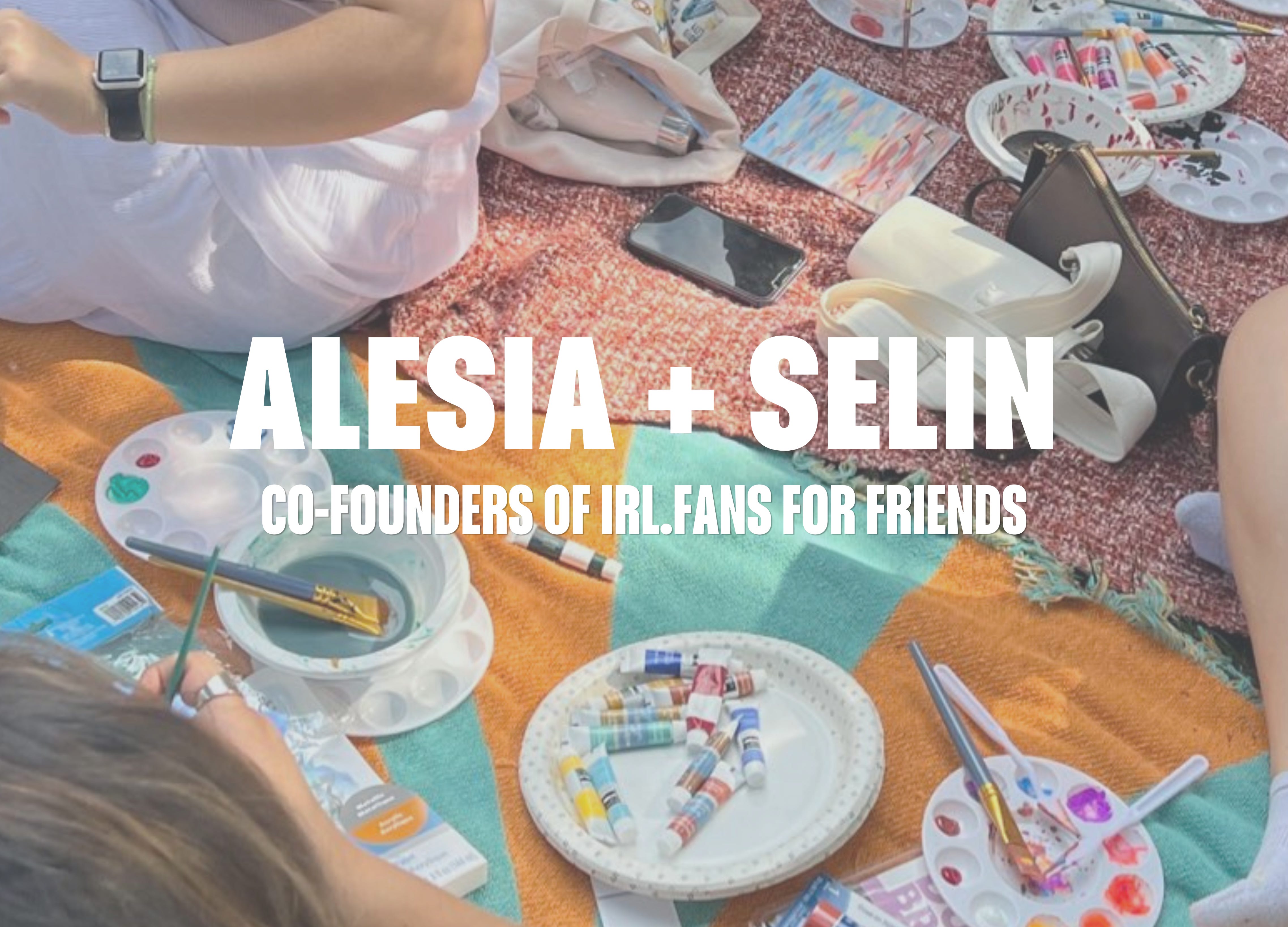
Below, they talk about what gets lost between online and offline fandom, what it takes to actually bring people together in person, and how those connections can turn into real-life friendships.
When you think about fandom spaces more broadly, what do you feel like they’re missing right now when it comes to real connection and how did that lead you to creating irl. fans for friends?
Selin: I think sometimes, especially in spaces like stan Twitter, people can kind of hide behind a screen and just say whatever they want. And the community you build online is really special, but you only really see it come together in real life when it’s something like a concert. And if there aren’t concerts happening in your area — especially if you’re from a place where artists don’t really tour — it’s very hard to bring that community into a real-life space.
You can feel really connected to someone online, especially when you share interests that your friends in real life might not have. So I think it’s really important to bring that in-person. We wanted to create something where that could exist more consistently.
Alesia: I was thinking the exact same thing. The reality is, the only time a bunch of fans come together if it’s music related is usually at a concert. So being able to take that same community and bring it into other spaces, whether that’s karaoke, dance parties, Pilates, a hot girl walk, whatever it is — it’s about translating that connection into other aspects of our lives.
You’re doing something different — bringing people together in real life, but not centering the event around fandom itself. How did you land on that model specifically?
Selin: I think like with friendships, it’s important to keep that retention. If you’re going to stay friends with someone, you need different things you can talk about — it can’t just be the fandom. We’ve only done one event in London so far, but in New York there’s been two, and I know Alesia is still connected to people from the first event. That’s because you end up bonding over other things happening in your lives. I think that’s really important.
Alesia: Yeah, I completely agree. If you have one thing in common, you probably have a bunch of other things in common too. And you can’t just always talk about Harry Styles or Olivia Dean or Taylor Swift — eventually that’s going to get old.
Being able to have activities is how real friendships form. I think about Selin — the first time we really hung out, we were doing all sorts of things. I only knew her because she was a fan of Harry, but after that we were going to pubs, thrifting, just doing normal things that weren’t about Harry. So it’s about taking that and bringing it into other spaces.
Selin: Yeah, and when we first met, I followed Alesia on Instagram, but we didn’t interact that much online. She was coming to London for a holiday, and I just DMed her like, stay at mine.
There was that sudden level of trust — you like this person, I like this person, there’s already a community in place. And Alesia was so down, she stayed for like 10 days. There was never a dull moment because we were just discovering all these other things we had in common and there’s suddenly a flourishment of a friendship. And now we speak every day. I think I speak to Alesia more than I speak to my parents.
What has been your favorite event so far?
Selin: We’ve only done three, but probably the second New York one.
Alesia: Yeah, I really liked that one. It was a little chaotic for me personally because I had a lot going on, but everyone else was awesome and great. I think Harries are some of the best people, everyone was just really gracious.
Selin: I think that was the first time we saw a proper community come together in real life that we were hosting. The first event in New York was about 20 people, and the London one was about 20 also. Then suddenly there were hundreds of people in the room, all with this excitement because the album had just dropped that day.
I was actually on the way to Marrakesh and Alesia FaceTimed me from the event to show me what it looked like. I was in the taxi to the airport just feeling overwhelmed with joy.
It was like, wow — I can’t believe we’ve brought all these people together and they’re all just dancing, singing, having the best time.
You see things like album listening parties happen online all the time, but seeing that happen in person felt really special. And I saw so many people tweeting about it, people I’ve followed for years but never actually seen, and suddenly I was like, oh my God, you’re there. That’s so cool.
Interested in reading more? In the full conversation, Alesia and Selin share how their own friendship took shape, what they’ve learned from bringing fans together in real life, and how irl. fans for friends is creating space for connection beyond the concert. Read it here.
The fan conversations and industry decisions shaping how entertainment is experienced right now.
Another year of Coachella is now in the books, and there was no shortage of massive fan moments — from Billie Eilish living out all of our fangirl dreams as “One Less Lonely Girl” during weekend two, to a stacked lineup of onstage team-ups: Sabrina Carpenter x Madonna, Olivia Rodrigo x Addison Rae, Sexyy Red x Lizzo, Zara Larsson x PinkPantheress, and so many more. One interesting bit of commentary among fans over both weekends, though, was how differently the two shows felt. Many headliners historically play nearly identical sets both weekends, but in 2026, weekend 2 was notably stacked with surprise guests and special moments. Worth watching whether this becomes the new normal.
Justin Bieber's headlining set also had the internet split, but either way, it got people talking. He leaned into the stripped-down, lo-fi world of SWAG and SWAG II, delivering something closer to an intimate late-night session than a big festival spectacle. Some fans loved it. Others called it lazy — a $10 million YouTube viewing party. But Justin was literally discovered on YouTube at 12, posting covers from his couch. Coming back to that platform and playing deep cuts from his past on the biggest festival stage in the world probably wasn't random. Some artists you just grow up with, and when they acknowledge that, even a little, it can truly hit different for their fans. Simplistic artistry vs. spectacle. Nostalgia and connection vs. heavy production. A lot of fans are debating it, but there really may not be a right answer.
It was a big month for ticket pricing accountability. Last week, federal jury ruled that Live Nation and Ticketmaster illegally maintained a monopoly over the live events market and overcharged concertgoers by $1.72 per ticket on average. On top of that, Live Nation settled a separate case with Washington D.C. for $9.9 million over Ticketmaster hiding fees until checkout and using fake countdown clocks to pressure fans into buying. StubHub got hit with the same thing — $10 million to the FTC for the exact same practice.
Three separate cases, with the same core complaint of fans feeling misled about what they'd actually pay. The monopoly verdict still has a long road ahead, as a judge has to determine final damages and remedies, which could include a forced breakup and additional payouts. But altogether, this week signaled that the era of junk fees and hidden costs in ticketing is getting harder to defend, and the fans who have been saying something was wrong all along are being proven right.
“Manufactured fandom” is a conversation fans are having right now, and it’s worth paying attention to. A Substack piece and a Billboard interview with marketing agency Chaotic Good pulled back the curtain on how some campaigns build online momentum, from seeding songs into content, partnering with influencers, and scaling comments to, in some cases, running actual fan accounts and participating inside fan communities while operating as a campaign. The reporting connected these tactics to emerging acts like Geese and major pop campaigns. Fans and industry observers online had mixed reactions — not to the marketing itself, but to the line between viral amplification and “manufactured fandom” (posting as fans, without disclosure).
Fan communities are built on trust, and the feeling that the people in them are actually there. When campaign strategy starts operating inside those spaces, it changes what the community actually is, and whether the enthusiasm you're seeing is real or directed. The industry has always worked to build hype, and the fan account strategy is not new. But as fans start to realize what’s happening behind the scenes, the question is whether this version crosses a line from smart marketing into something that undermines the spaces fans built themselves.
At GRAMMYS on the Hill, three AI bills are moving through Congress that would give artists rights over their voice, image, and likeness in AI-generated content, let creators find out if their work was used in AI training, and require disclosure of copyrighted training data. The more artists can protect their work and identity, the more the music and art you love actually belongs to them. If you want to make your voice heard, the Recording Academy has ways to support creators here.
Ticketmaster and Seated announced a partnership that turns sold-out waitlists into a verified ticket distribution channel, with the goal being to get released tickets to real fans instead of scalpers. Fans sign up, verify their identity, and can either get notified when tickets drop or enable an AutoBuy feature, with fulfillment handled by Ticketmaster.
Spotify and NIVA announced a year-long partnership to boost independent venue visibility inside Spotify’s Live Events Feed, making it a little easier for fans to find and show up for the shows that keep local scenes alive.
Thanks for reading Fangirl Forward — where we push fandom forward by connecting fan skills to career pathways, centering fan perspectives in industry conversations, and building more informed, intentional fan communities.
Beyond the newsletter, we publish cultural analysis (Forward Focus), fan-led live event reporting (From the Crowd), and industry explainers (FANFAQ).
Fangirl Forward is part of Fan Fave Media, a creative studio focused on entertainment storytelling, live experiences, and cultural strategy that amplifies emerging voices.
Want to be part of the conversation?
➡️ Get in touch to for a feature interview
➡️ Follow @fangirlforwardhq and @fanfavemedia for updates
New editions publish every other Wednesday.